401Da / SM32
|
|||||||||||||||||||||||||||||||||||||||||||||||||||||||||||||||||||||||||||||||||||||
|
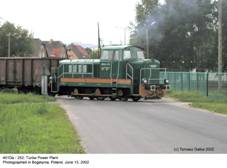
This 401Da-252 belongs to the Turów power
plant and was photographed in Bogatynia on
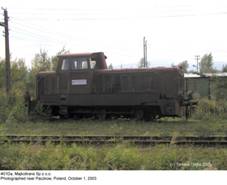
401Da (number unknown), Majkoltrans (probably withdrawn),
photographed near Paczków on
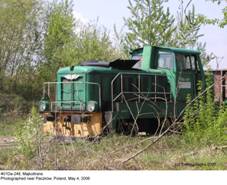
401Da-248 from the same company, photographed near Paczków on
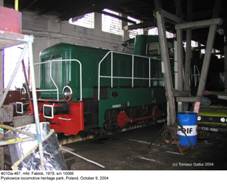
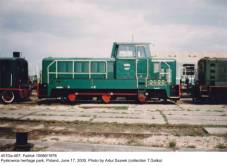
401Da-467 (Fablok
10066/1978) belongs to the TOZKiOS railway fan society collection and was
photographed in Pyskowice on
Another picture of the 401Da-467, taken on June 17, 2005. Photo by Artur Szarek (from my
collection).
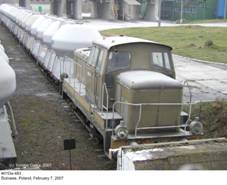
401Da-483, photographed at a cement storage yard in Ścinawa on
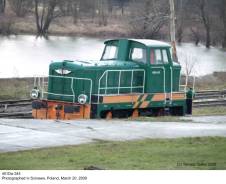
401Da-345, photographed at the same location on March 20, 2009.
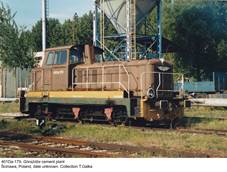
One more picture from this location: 401Da-179, date unknown. Photo
from my collection.
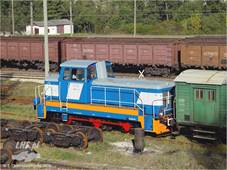
SM32-001, Sędziszów Północny,
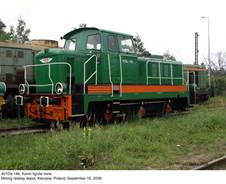
This 401Da-146, operated by the Konin
lignite mine, was photographed at the mining railway depot in Kleczew on September 16, 2008.
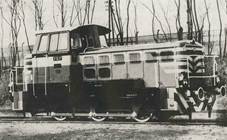
This somehow mysterious picture of a ‘SM31-001’ has been taken from the book published in 1974 to commemorate 50 years of Fablok. Designation, possibly retouched, suggests PKP and was later used with a completely different machine.
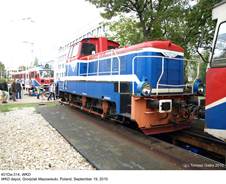
401Da-314 is used for switching at the WKD suburban railway depot in Grodzisk Mazowiecki; photo taken on September 2, 2009.
Another picture of this locomotive, taken during the ‘Public Transport Days 2010’ at the same location on September 19.
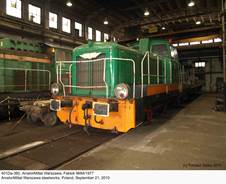
Two days later, together with my friend Chris West, we visited ArcelorMittal Warszawa steelworks that still operate a number of 401Das. This example is 401Da-380 (Fablok 9684/1977)…
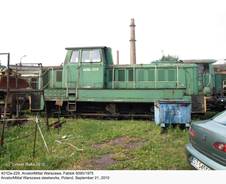
… next come 401Da-229 (Fablok 9390/1975), in much poorer condition…
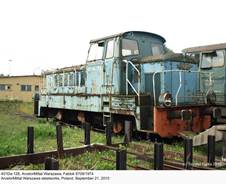
…even more derelict 401Da-128 (Fablok 8709/1974)…
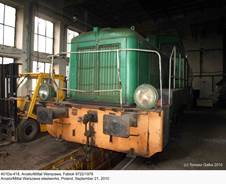
…401Da-418 (Fablok 9722/1978), intended for sale…
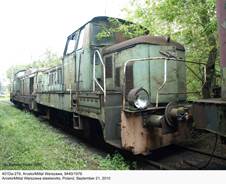
…and withdrawn 401Da-279 (Fablok 9440/1976).
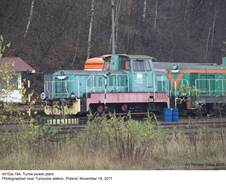
This 401Da-194, operated by the Turów power plant, was photographed near the Turoszów station on November 18, 2011.
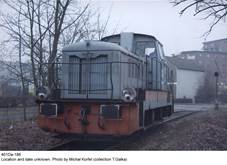
401Da-186…
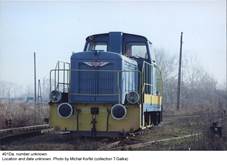
…and a second 401Da, number also unknown. Both photos by Michał Korfel (from my collection).
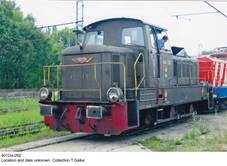
401Da-262, location and date unknown; this locomotive is probably operated by ZNLE Gliwice repair works, now controlled by Newag. Photo from my collection.
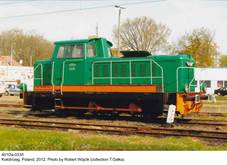
Three pictures by Robert Wójcik (from my collection): 401Da-0335, Kołobrzeg, 2012…
…401Da-384, Słupsk, 2010…
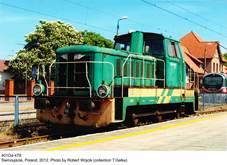
…and 401Da-478, Świnoujście, 2012.
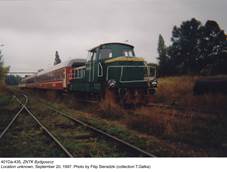
401Da-435, operated by ZNTK
Bydgoszcz rolling stock repair establishment (now PESA). Location unknown, September 20, 1997. Photo by Filip Sieradzki (from my collection).
Three postcards from my collection (photos by Marek Kowalski, taken at
the Fablok
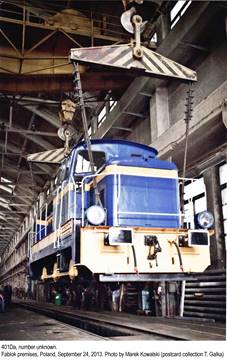
premises on September 24, 2013): an unknown 401Da during overhaul…
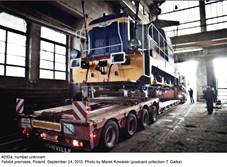
… another picture of this locomotive (most probably the last one
overhauled by Fablok)…
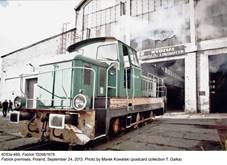
… and 401Da-499 (Fablok 10098/1978), which is the manufacturer’s property.
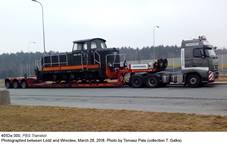
401Da-300, operated by PBS Transkol, on a low-loading semi-trailer, photographed
between Łódź and Wrocław
on March 28, 2018. Photo by late Tomasz Pala (from my collection).
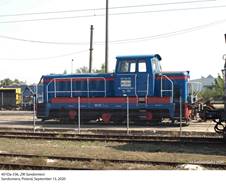
401Da-336, operated by ZIK
private operator. Photographed at the company’s premises in Sandomierz on September 13, 2020.
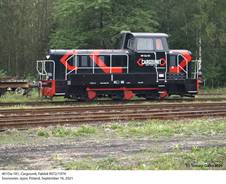
Originally built for Baildon steelworks of Katowice and numbered 4, this
401Da-181 (Fablok
9072/1974) is now owned by Cargounit locomotive rental company. Sosnowiec Jęzor, Poland, September 16, 2021.
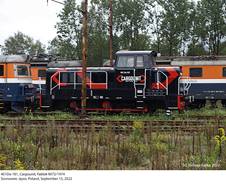
Another picture of this locomotive, taken at the same location almost
exactly one year later, on September 15, 2022.
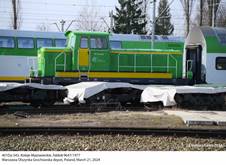
401Da-343 (Fablok
9647/1977), purchased by Koleje Mazowieckie from an industrial operator in 2022,
photographed at the Warszawa Olszynka Grochowska depot on March 21, 2024. |
First Polish diesel
switcher with electric transmission, SM30 (initially designated LWe55,
factory type 1D) from Fablok appeared in
1956. Until 1970, over 900 examples were built, for both PKP and
numerous industrial operators; many still remain in use. SM30 had been
conceived as a simple and undemanding locomotive that could be rapidly put
into production; therefore, off-the-shelf components were used wherever
possible. Diesel engine was
derived from a power unit used in military vehicles and light vessels, 600 V
DC generator was developed from a stationary unit and traction engines were
of the type used in streetcars. Despite several modifications, this design
had little potential for further development and its intended successor, SM25
(factory type 9D), appeared as early as in 1960. This locomotive was fitted
with hydraulic transmission, but, as torque converters were not manufactured
in Poland, it was never put into production. Electric transmission had to be
retained and this led to the next prototype, Fablok type 401D, which
appeared in 1966. Type 401D owed much to both SM25 (general three-axle
layout, but was longer by almost 1.4 m and heavier by three tonnes) and SM30 (3DVS diesel engine). Prototype was
completed in 1966 and underwent tests with PKP, but results were not entirely satisfactory. Main objections
concerned obsolete prime mover, production of which was to be terminated
soon. Moreover, running qualities at higher speed left much to be desired.
3DVS diesel was thus replaced by the license-built Henschel 12V1416A of the same
rating. This variant, which also featured several minor improvements, was
designated 401Da and appeared in 1968. Production began in 1971 (after
phasing out SM30) and lasted until 1979. Most sources give that 500 examples
were built, excluding the sole 401D. Although externally 401Da (sometimes designated also
Ls350) resembles earlier switchers from Fablok, it can be easily
distinguished by outer frame and three axles coupled by connecting rods. This
allows for negotiating curves with the radius of 80 meters. First and third
axles are driven by nose-suspended electric motors. Although this locomotive
can be in principle used for light freight trains, just as the SM30, it is
used almost exclusively for switching: maximum speed of 60 km/h, axle load of
13.5 tonnes and tractive effort of 11.3 tonnes at startup (less than SM25, but by about 40% more
than SM30) are sufficient for such jobs. 401Da is sometimes confused with
SM25 – of the latter class, only three examples were built and their service
was rather short. 401Da was never ordered by PKP (who obviously seemed satisfied with obsolescent SM30s) and
was built for industrial operators only. Individual examples were typically
identified by factory designation plus consecutive numbers, not serials. They
went to numerous industrial establishments and can be encountered on factory
tracks and sidings throughout the country. In early 1970s there were plans to
build this locomotive also for PKP; designation SM31 is even quoted –
in fact SM31, or factory type 411D, appeared in 1976 and was a completely
different design. These plans never saw fruition. The 401D prototype was in
fact briefly tested by PKP as SM31-001 in 1966, but found unsuitable
due to uneasy running above 30 km/h. Most probably it was later sold to
industry. In late 2006, however, second-hand 401Da-254 was purchased by the LHS broad-gauge line, a PKP subsidiary, and hence was given
new PKP-style designation SM32-001.
This has caused some confusion, as this ‘new’ locomotive has nothing to do
with SP32; its new designation is thus formally not consistent with the PKP system (SM33 would have been more
appropriate). SM32-001 has not been converted to the 1524 mm gauge (with
outer frame this could cause some problems) and is used for switching at the Sędziszów Północny transfer
station. According to some Internet sources, a few locomotives of this type
are used for auxiliary duties at PKP
service and maintenance facilities, but all have ‘industrial’ designations;
details are lacking. Two further developments of type 401Da never saw
fruition. Type 406D was to be fitted with supercharged Wola H12 diesel engine, rated
at 530 hp, and three electric motors; it was
intended to commence its production between 1976 and 1980. Type 401Db of
1977, later re-designated 415D, featured improved suspension. Both these
types remained on the drawing board. Main
technical data
1)
Also 16H12A, in later and/or modernized examples. 2)
In series since 1971; prototype 401D with Wola 3DVS
diesel built in 1966. 3)
Including the 401D prototype. References
and acknowledgments
-
LSPP, AL; -
Tomasz Ciemnoczułowski
(private communication – thanks for the photo!). |
||||||||||||||||||||||||||||||||||||||||||||||||||||||||||||||||||||||||||||||||||||