LDH70
|
|||||||||||||||||||||||||||||||||||||||||||||||||||||||||||||||||||||||||||||||||||||
|
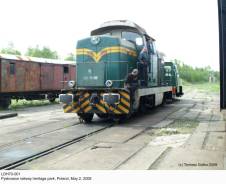
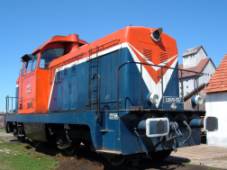
LDH70-001,
previously used by HSW steelworks, photographed at the TOZKiOS
premises in Pyskowice on May 2, 2009.
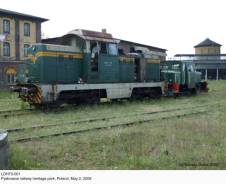
Another picture of this locomotive, taken on the
same occasion.
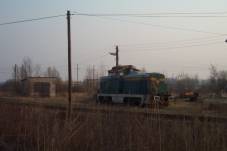
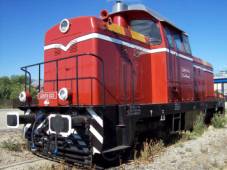
LDH70-003,
owned by Majkoltrans, photographed near Paczków on March 29, 2003.
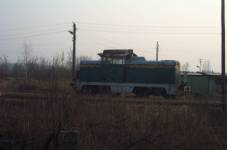
Another
picture of the LDH70-003, taken on the same occasion; the condition of the
locomotive suggests that it has seen no service for some time. Both pictures
by Marek Dąbrowski (www.kolejowaklatka.org - thanks for
permission!).
LDH70-557 from a
Romanian industrial operator, photographed in Miercurea Ciuc on April 13,
2007.
Another Romanian
industrial locomotive: LDH70-323, Fundulea, July 7, 2007. Both pictures by
Stefan Puscasu (http://cfr.stfp.net
– thanks for permission!).
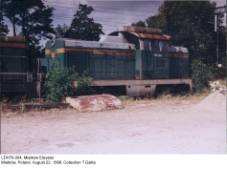
LDH70-004 was used
by the Mietków Elevator; date of withdrawal is not known. This photo, taken
on August 22, 1998, shows this locomotive already in a rather poor condition.
Photo from my collection.
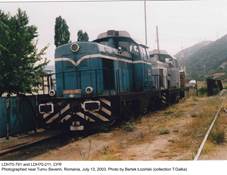
Romanian LDH70-791
and LDH70-211, photographed near Turnu Severin on July 13, 2003. Photo by Bartek
Łoziński (from my collection). |
In early 1960s Romanian works Uzinele
23 August (former Malaxa, now FAUR)
developed a family of diesel locomotives with hydraulic transmission, both
for line work and switching. They were designated LDH plus a number given
approximately by rated power divided by ten. These locomotives, from LDH18 to
LDH240, covered a very broad power range and were built in considerable
numbers, both for Romanian operators (state railways CFR and industry)
and for export. Some also had their narrow-gauge equivalents. LDH70, intended mainly as a medium switcher, found
widespread use, mainly in Romania but also abroad. Externally it was almost
identical with LDH45 and LDH55, including dimensions, and differed mainly in
prime mover – a 12-cylinder MB820Bb diesel, built on the Maybach licence, with a Brown-Boveri
turbo-supercharger. Depending on engine version and settings, rated power
ranged from 750 to 850 hp (552 to 626 kW). TH1A
transmission gear was manufactured under Voith
license. First orders from CFR and industry came in
1965 and production continued for over twenty years. According to www.le-rail.ch (see References), total
output was 993 examples. Romanian industrial enterprises received the
majority of them, namely 808. CFR had 79 examples, classed 85 and used
mainly for switching. These numbers include 96 examples fitted with 700 hp M836SR diesel engine, supplied between 1972 and 1980
and designated LDH70 SR. Probably all have already been withdrawn; a few
still remain in use with minor private operators (two with Rompetrol Logistics). Second recipient were
Hungarian state railways MÁV and private GySEV, which took delivery of
38 examples; some (seven?) were later sold to industry. They were classed
M47.1 (later 2147); in February 2006 only ten of the original variant
remained in service with MÁV. Some were re-engined
with 855 hp MTU engines (class M47.12, later
2247); a number were additionally fitted with ballast to increase tractive
effort (class M47.13, later 2347). In January 2008 these two modernized
classes numbered 40 and 28, respectively, but some of these had been
converted from very similar MÁV class 43 (LDH45). Other orders,
although diverse, were smaller and included: -
Austria:
2 examples (industry); -
Czechoslovakia:
19 examples (class 748.4, all for industry); -
Egypt: 7
examples (industry); -
Greece:
19 examples (OSE class A.151, switching only, delivered in 1972, probably
three or four still in use); -
Northern
Korea: 11 examples (industry); -
Syria: 1
example (industry); -
Turkey: 6
examples (industry). As data concerning industrial operators are scarce,
it is difficult to estimate how many LDH70s are still in use, but certainly
their number is not large. Polish state railways PKP did not purchase
these engines; indigenous 800 hp SM42 has been
built in large numbers and experience with hydraulic transmission (used in
SM15 and SM25) was rather discouraging. LDH70s were purchased only for
industry, in small numbers – most probably, five examples in all. Little is
known on their service. LDH70-001, used by the HSW steelworks, has
been preserved and can now be seen at the Pyskowice
loco heritage park. There are plans to restore this locomotive to working
order. LDH70-003 and LDH70-004 were still in use in early 2000s, but have
been withdrawn; on the remaining two examples I have no information. Three-digit
service numbers might have been thought to indicate an intention to purchase
these locomotives in much larger numbers. Most probably, however, they were
assigned by the manufacturer. Main
technical data
1)
Line operation / switching. References and acknowledgments
-
Tamas Haller (private communication – thanks a lot!); -
www.le-rail.ch
(website by Theo Stolz); -
www.tozk.glt.pl (TOZKiOS Pyskowice website). |
||||||||||||||||||||||||||||||||||||||||||||||||||||||||||||||||||||||||||||||||||||