S200
|
|||||||||||||||||||||||||||||||||||||||||||||||||||||||||||||||||||||||||||||||||||||
|
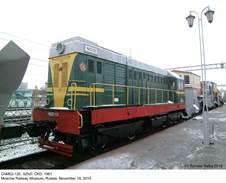
Predecessor to Soviet class ChME3 (and Polish
S200) was four-axle ChME2, supplied in fairly large numbers. ChME2-120, built
in 1961, is currently on display at the Moscow Railway Museum; November 19,
2015.
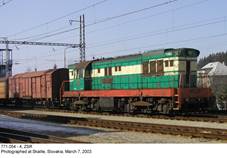
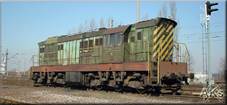
ŽSR 771.054-4, photographed
at
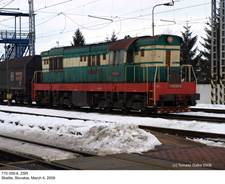
ŽSR 770 058-6,
photographed at the same location almost exactly six years later, on March 4,
2009.
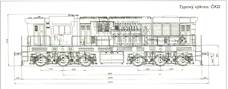
T669 drawing by ČKD,
from AV
vol.2
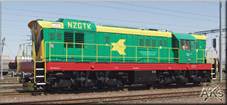
This S200-284, operated by NZGTK,
was photographed at the Piast
colliery on
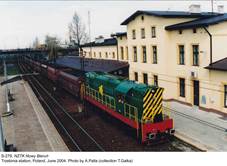
…while this S200-276, also from NZGTK, photographed at the same location on
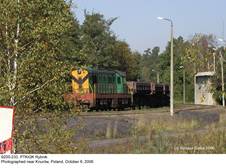
S200-233, PTKiGK Rybnik,
photographed near Knurów on
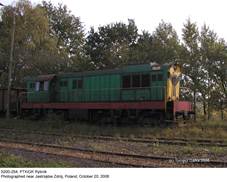
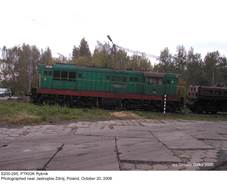
S200-254, PTKiGK Rybnik,
photographed in Jastrzębie Zdrój on
...and S200-295 from the same company, heading for
a spoil bank near Borynia
colliery; photo taken on the same day.
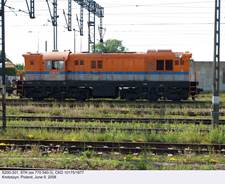
S200-301, STK
(ex 770 540-3), photographed in Krotoszyn on
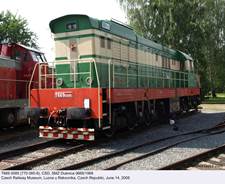
T669 0085, ČSD,
Czech railway museum, Lužna u Rakovnika, June 14, 2008.
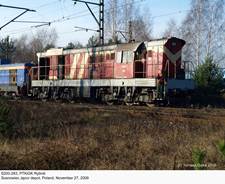
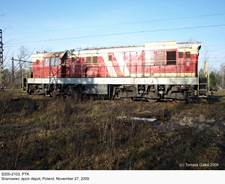
S200-283, PTKiGK Rybnik,
photographed near the Sosnowiec Jęzor depot on November 27, 2009.
S200-2103, also from this company, photographed on
the same occasion. More pictures of S200s operated by PTKiGK
Rybnik can be found here.
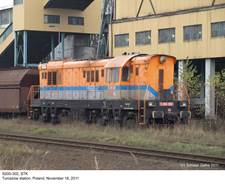
S200-302, STK, photographed at the
Turoszów station on November 18, 2011.
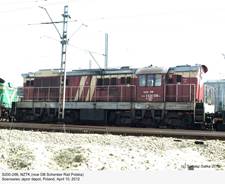
S200-296, DB Schenker Rail Polska
(still in old NZTK livery, photographed at the Sosnowiec Jęzor depot
on April 10, 2012.
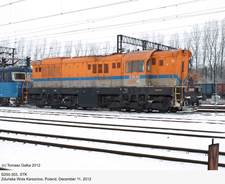
S200-303, operated by STK; Zduńska
Wola Karsznice, December 11, 2012.
S-279 from the NZTK Nowy Bieruń
fleet, photographed in Trzebinia in June 2004. Photo by A.Palla (from my
collection).
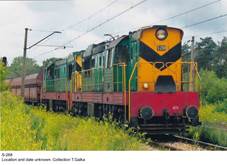
S-268 and another S-200 double-heading a heavy
freight train somewhere in Upper Silesia, date unknown. Photo from my
collection.
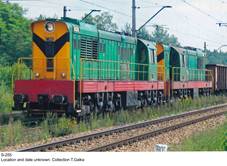
Similar task is performed by S-255 and another
S-200. Photo from my collection.
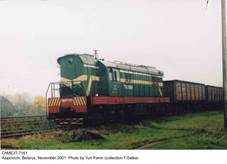
Three photos of ChME-3s. This ChME3T-7161
was photographed in Asipovichi, Belarus, in November 2001. Photo by Yuri
Panin (from my collection).
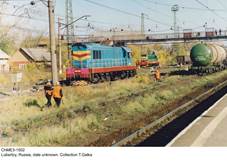
ChME3-1502, Lubertzy, Russia, date unknown. Photo
from my collection.
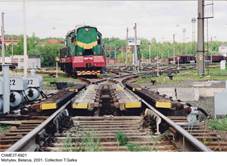
ChME3T-6921, Mohylev, Belarus, 2001.
Photo from my collection.
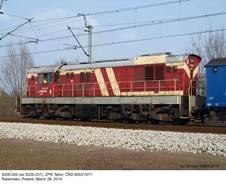
S200-200 (formerly S200-231) was sold by DB Schenker Polska to Tabor
private operator in 2013; photographed in Radomsko on March 28, 2014.
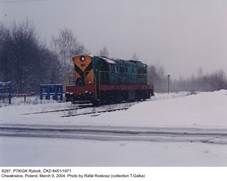
S297, photographed in Chwałowice on March 9, 2004. Photo
by Rafał Roskosz (from my collection).
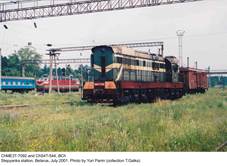
ChME3T-7092, Belarussian railways, with
the ChS4T-544 in the background. Stepyanka, Belarus, July 2001.
Photo by Yuri Panin (from my collection).
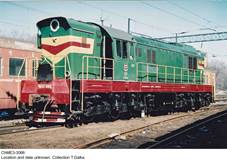
All I know about this photo is that the locomotive
is ChME3-3066. From my collection.
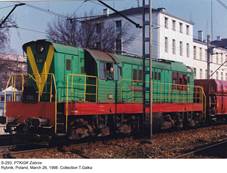
S-293 (ČKD
14484/1986), operated by PTKiGK Zabrze,
Rybnik, March 26, 1998. This locomotive has already been withdrawn. Photo
from my collection.
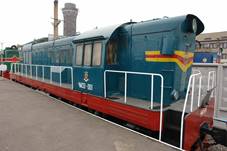
First ChME3 delivered to the USSR: ChME3-001, built
in 1963, on display at the Varshavskiy railway station in St. Petersburg.
Photo by George Shuklin (www.commons.wikimedia.org).
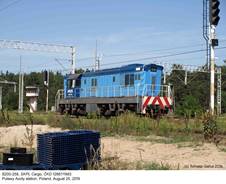
S200-258 (ČKD
12667/1983), photographed at the Puławy Azoty station on August 25, 2019. This locomotive was
originally purchased for PTKiGK Rybnik, then taken over by DB
Schenker / DB Cargo Polska
and sold to SKPL Cargo private
operator in August 2017.
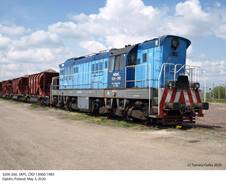
S200-260 (ČKD
13060/1983), originally purchased for industry, was taken over by DB Schenker Rail Polska
in 2010 and sold to SKPL
in 2016. Photographed in Dęblin on May 3, 2020.
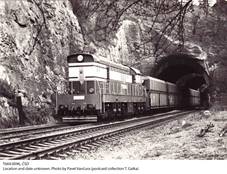
Czechoslovakian T669.0096, location and date
unknown. Photo by Pavel Vančura (postcard from my collection). |
Although
locomotives designated S200 were built in Czechoslovakia and are used in Poland,
their origin can be traced in the USA and the USSR. To
begin with, during the first half of 1945 68 heavy diesel switchers with
electric transmission from the ALCO
RS family were supplied to the USSR. These machines of Bo’Bo’ layout had axle
load of almost 30 tonnes, quite high for European and especially Russian
standards, so they were supplied in a modified six-axle (Co’Co’) version.
Designated Da20 (Дa20 in Russian script) and
later simply Da for Diesel-ALCO,
they were much more modern than contemporary Soviet counterparts, so their
clones were promptly ordered in quantity as TE1 (road diesels built in
Kharkov between 1947 and 1949) and TEM1 (switchers built in Bryansk between
1958 and 1968). TEM1 was further developed into what finally became the most
prolific family of Russian diesel switchers; its offspring includes the TEM2,
used in Poland in fairly large numbers and designated SM48 (described under a
separate entry). The
demand for heavy switchers in the USSR was much higher than capabilities of
national locomotive industry, so large orders were also placed with
Czechoslovakian manufacturers. ČKD
factory of Prague had supplied considerable number of ChME2
(ЧМЭ2 in Russian script) machines, roughly equivalent to
Czechoslovak classes T435 and T458 (522 examples purchased by the USSR
between 1958 and 1965). These locomotives were considered very reliable, but
too light for most tasks, so there was a demand for a switcher with the
tractive effort of TEM1 and reliability of ChME2. Although preliminary drafts
of such machine were prepared in a hotel room in Moscow, in conditions hardly
resembling a design office, they resulted in a successful locomotive that
remained in production for over thirty years, with 8200 examples built. In
Czechoslovakia they were designated T669 (after 1995, class 770 or 771,
depending on the particular variant). Vast majority (7455 machines) went to
the USSR, where they served as the ChME3 class; they still remain in service
in the CIS. 402 examples went to ČSD
and national industrial operators and the rest were exported to Albania (61, HSH class T669, delivered in six small
batches between 1968 and 1990), India (12, for two steel plants, class
DEC120), Iraq (100, class DES3100), Syria (25, class LDE1500) and Poland. T669
or ChME3 makes an interesting comparison with its Soviet counterpart TEM2, as
they both were developed from the same basic ALCO’s design. They are similar in appearance and have similar
ratings. In general, Czechoslovak machine is considered more reliable and
having better overall workmanship quality, while the Soviet one is more
robust and suited for operation in extreme weather conditions. Due to
similar, slow-running (750 rpm) engines, both developed from American design,
they also sound much the same – and loud. It is perhaps worth mentioning here
that the crowning achievement of heavy diesel switcher design at the ČKD was the ChME5, an eight-axle
(Bo’Bo’Bo’Bo’), 2000-hp machine. It was intended to build 2000 locomotives of
this class for the USSR until the year 2000 (Communists always liked round
figures), but in 2000 neither Czechoslovakia nor the USSR existed… Both
TEM2s and T669s were purchased for Polish railways. Contrary to the Soviet
machine, used both by PKP (as SM48)
and various industrial operators, Czechoslovak switchers were purchased
mainly for metallurgical plants and sand railways in the Upper Silesia. These
machines were supplied between 1966 and 1990 and classed S200. The reason for
this odd practice (other locomotives used by industrial operators usually
retained their factory type designation) is that 62 examples went to Lenin steelworks (now part of the Arcelor
Mittal corporation), which had their own system. These steelworks were
the largest single user of this class in Poland. All diesel locomotives were
designated there by an alphanumerical symbol beginning with S: for example,
S100 corresponded to the PKP class
SM41 and S400 – to SM42. This was later extended over an entire class. In
all, 143 examples were purchased. Two more (S-229 and S-230), damaged en
route to Poland in 1977, were not delivered and remained in Czechoslovakia,
becoming T669.0109 and T669.0540, respectively; their Polish designations
were then used again. Further two (S-2140 and S-2141) of 1989 were also not
delivered – for reasons unknown to me – and became T669.0538 and T669.0539,
respectively. There is some confusion about service numbers. Initially
locomotives delivered to the Lenin
steelworks were numbered S201, S202 etc. This scheme was continued with other
operators, so that the first locomotive delivered to sand railways became
S229. S299 was followed not by S300, but by S2100, then came S2101 and so on.
Many examples – especially those from sand railways – were later given
re-arranged service numbers, so that S229 became S200-229. To complicate
things even further, fourteen S200s were given new service numbers with new
owners; as a result, numbers from S249 to S262 inclusive are used twice. Despite
rather obsolescent basic design, Polish S200s will probably remain in
operation for a long time, hauling heavy trains on industrial lines and
sidings; they had been designed for such tasks. In 2006 largest fleets of
S200s were operated by PTKiGK Rybnik company (43 examples) and NZGTK company of Nowy Bieruń (14). Both these
companies were later absorbed by DB
Schenker Rail Polska; currently (mid-2014) this operator has a fleet of
33 examples. All locomotives owned by Arcelor
Mittal Poland were transferred to newly-formed PUK Kolprem company, which now has 29 examples. Another major
operator is Lubelski Węgiel (a
company that operates collieries in the Lublin area – 16 examples). Several
S200s were withdrawn and scrapped or sold; a few went back to Czech Republic
or Slovakia. In
November 2006 a second-hand Czech machine appeared in Poland, namely
770.540-3 (ex T669.0540 – initially intended for Poland, but never delivered,
operated by Doly Nástup Tušimice, ČKD 10175/1977). This locomotive was
purchased by STK, a private
operator specializing in the out-of-gauge cargo, and is currently designated
S200-301. Later STK purchased also S200-302 (April 2008), S200-529
(November 2009) and S200-303 (June 2010). In August 2008, the 770.528-8 (ČKD 13556/1984) followed and joined
the CTL Logistics fleet as S200-528; in February 2014 it was sold to Ecco Rail, a new company formed in
2011. Next example was 770.521-3 (ČKD 12101/1981), operated by a foundry in
Ostrava until 2003, which arrived in April 2010 to join the Transoda fleet as S200-530. S200-512 (former 770.512) was purchased by
Kolej Bałtycka in July 2011 and
S200-304 (former 770 526-2, ČKD
13554/1984) by SKPL Cargo in April
2014. S200-304 returned to Czech Republic in February 2018; after an overhaul
by CZ Loko it was sold to Albanian
operator Albrail in May. Modernizations
of these locomotives were focused mainly at replacing obsolete and
uneconomical K6S310DR engines with modern units. One machine (S-269) was
modernized by PTKiGK Rybnik in
1996 and fitted with MTU
12V396TC14 12-cylinder diesel engine rated at 1050 kW and LSG-1200-90
generator with state-of-the-art control electronics. In the Czech Republic,
ten machines were also modified and re-designated class 773; they have Caterpillar 3512DI-TA/2 engines rated
at 1300 kW and lowered engine cowlings. Probably all are used by ČD as heavy freight road locomotives.
Slovak modernization (class 772), with Pielstick
8PA4-185M4 engine, rated at 960 kW, and elegant streamlined silhouette, has
remained a single example. Main
technical data
1)
Plus 4 examples not supplied to Poland; included six
second-hand locomotives purchased until June 2010. 2)
73:18 in Soviet machines (ChME3). 3)
Some Czechoslovak versions 114 600 kg and 19.1 T,
respectively. 4)
MTU 8V396TC14 785 kW in the modernized version. References
and acknowledgments
-
AV vol. 2; -
www.kolejowaklatka.org (website
by Marek Dąbrowski); -
SK, various issues; |
||||||||||||||||||||||||||||||||||||||||||||||||||||||||||||||||||||||||||||||||||||