ET13 / 140
|
|||||||||||||||||||||||||||||||||||||||||||||||||||||||||||||||||||||||||||||||||||||||||||||
|
Until I spot a Polish ‘Bobina’,
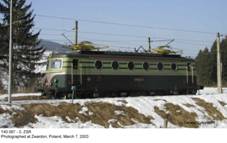
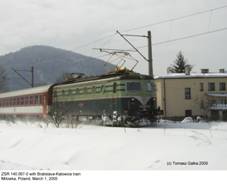
I’d like to present two photos of the ŽSSK
140.067: this one was taken in Zwardoń on
...
and this one on
Another
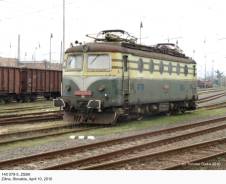
Slovakian ‘Bobina’: 140 079-5, photographed in Žilina on April 10, 2010. This locomotive was sold to STK in September 2012.
140
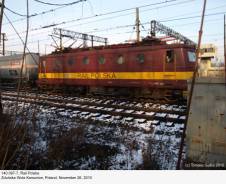
097-7 from the Rail Polska fleet tries to escape my camera: Zduńska
Wola Karsznice, November
26, 2010.
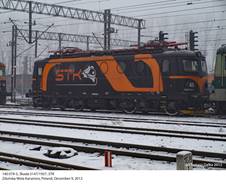
140
079-5 from the STK fleet, photographed at
the same location on a cold and misty day of December 9, 2012.
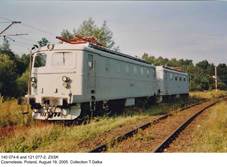
140 074-6
before repainting, photographed in Czarnolesie on
August 19, 2005; the other locomotive is 121 077-2. Photo from my
collection.
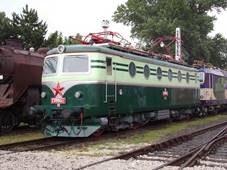
140 062, ŽSSK, is a heritage locomotive
owned by Železničný Klub Tatran. Photo taken in Bratislava,
Slovakia, on June 25, 2022, by Sebastián Langhoffer (thanks for permission!). |
In
late 1940s, in view of planned electrification of main lines, Czechoslovak
state railways ČSD sought for a modern universal electric
locomotive with a potential for further development. Suitable machine was
found in Switzerland. It had been designed for Berg-Lötschberg-Simplon Bahn (BLS) and first example was accepted in
November 1944; in all, eight were built for this railway until 1955. They
were also built for state railways (SBB), which received 100 examples
between 1946 and 1951. In 1949, well-known Škoda
works of Plzeň acquired license rights to build
this locomotive. Agreements were signed with Schweizerische
Lokomotiv- und Maschinenfabrik
of Winterthur and Société Anonyme des Ateliers de Sécheron
of Genéve; first example was completed in 1952
and accepted by ČSD in 1953. After
trials, of which some took place in Poland, 100 machines were supplied for
Czechoslovak state railways as class E 499.0 in six batches, differing in
minor details – factory designations type 12E1 through 12E6. Two were built
for the Soviet Union (class ChS1, or ЧС1 in Russian script –
factory designation type 24E1) and ten for Northern Korea (factory
designation 22E1). I have no information on Korean locomotives (not a big
surprise, anyway); in the USSR, first two ChS1s were supplied in 1957 and
remained in use until 1971. Later a batch of 100 machines with the same
designation followed, but this was in fact a modified version (factory
designation 41E0 and 41E1); last of them, ChS1-102, was in fact a prototype
of class ChS3, with further modifications and uprated AL-4846eT traction
engines. First production locomotives – easily
distinguishable by round side windows – immediately proved very successful
and remained in use for a long time. Their designation in the ČSD service was later changed to class 140 and their common
nickname was ‘Bobina’, after the axle arrangement.
Most of them were withdrawn in the 1990s and supplanted by more modern
classes 162 and 163. Several have survived into 21st century with ČD (Czech Republic) and ŽSSK (Slovakia); according to Marco
van Uden (http://mercurio.iet.unipi.it)
in the beginning of 2003 ČD had six
machines in use and ŽSSK four. In
2006 ČD had only four, of which three were intended for preservation as
historic machines, while one Slovakian 140 was handed over to ŽSCS, a subsidiary of ŽSSK, and other three (140.045, 058 and 067)
served on the Žilina – Katowice line, linking
Slovakia with Poland. Last of them, 140.067, hauled the ‘Góral’
express train for the last time on December 9, 2006. Further two locomotives
of this type (140.062 and 087) on occasions visited southern Poland with
freight trains. ŽSSK 140.047-2 (ex ČSD E499.047, Škoda 3115/1957), withdrawn from use in
1995, has been preserved as a heritage loco and is kept in working order in Žilina. When, in early 21st century, private
railway operators emerged in Poland, purchase of second-hand foreign
locomotives was usually for them the most reasonable option. Many came from
Czech and Slovak railways, who had a number of surplus machines at hand.
140s, although rather elderly, were also included. First two appeared in
Poland in August 2005: these were 140.099 and 140.074, purchased by CTL
from ŽSSK (first Polish locomotives of this type came from
Slovakia). They were redesignated ET13-R001 and
ET13-R002 (why not ET12? Surely, CTL is not superstitious!). 140.064 followed in
December 2007; this locomotive became ET13-R003. ET13-R001 (Škoda 3629/1958) was sold to Czech Republic in
March 2010, but returned to Poland in January 2012, this tile leased to STK;
in August 2017 it was transferred to Ecco
Rail. ET13-R002 (Škoda 3142/1957) was
sold to ŽOS Zvolen in Slovakia in 2009;
between November 2013 and March 2014 it was leased to Rail Polska. ET13-R003 (Škoda
3132/1957) was withdrawn in April 2014 and offered for sale as scrap. Rail
Polska obtained its first machine of this type
in January 2007: 140.059-7 (Škoda 3589/1957) was in fact their very first electric
locomotive. Next came 140.097 (Škoda
3627/1958) in November 2007. Both are still in use. 140.052 (Škoda 3120/1957) was sold to PHU Lokomotiv in 2008; it was leased to Kolej Bałtycka,
then to Ecco Rail and finally sold to
Czech Republic in October 2018. They were followed by 140.042 (Škoda 3110/1957) and 140.079 (Škoda
3147/1957) for STK, in May and September 2012, respectively. Both were
leased; they returned to Czech Republic in 2016 and 2017. Further purchases
seem unlikely, as there are few ‘Bobinas’ available
for sale: both in Czech Republic and Slovakia they are considered heritage
locos and some even haul special trains. Purchase of 50-years old locomotives can be seen
either as an act of desperation or as appreciation of their qualities. It
should be kept in mind, however, that PKP
class EP05 (of which the last example ran with a scheduled train in May 2008
and is still serviceable) was in fact a direct development of the original ‘Bobina’
and differed mainly in details. Main
technical data
1)
Including 2 for SZD (class ChS1)
and 10 for 2)
Until April 2014. 3)
140.001 through 017 – 15 600 mm, 140.018 through 040
– 15 800 mm. References and
acknowledgments
-
Monographic article on class 140 by Bogdan Waga (KMD vol. 2/2005); -
AV, AL; -
SK, various issues; -
www.kolejowaklatka.org (website by Marek
Dąbrowski); |
||||||||||||||||||||||||||||||||||||||||||||||||||||||||||||||||||||||||||||||||||||||||||||