Pk1
|
|||||||||||||||||||||||||||||||||||||||||||||||||||||||||||||||||||||||||||||||||||||||||||||||||||||||||||||||||||||||||||||
|
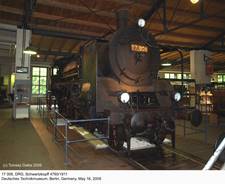
DRG 17 008 (BMAG
4760/1911) on display at the Deutsches Technikmuseum, Berlin.
Photo taken on May 16, 2009.
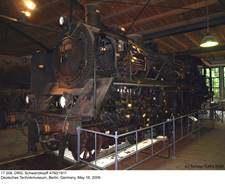
Another picture taken on this occasion, showing
boiler internal details.
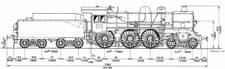
DRG Class 170-1, side drawing © Lokomotiv-Revue (from TB
vol.1).
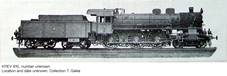
An unknown KPEV S10; details are lacking. Photo from my collection.
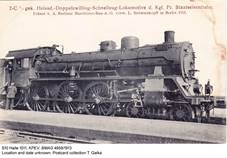
KPEV Halle 1011 (BMAG
4958/1913), location and date unknown. Re-numbered 17 052, this engine
later served with DRG and was
withdrawn after 1925. Postcard from my collection.
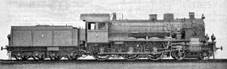
KPEV Erfurt 802 (BMAG
4456/1910). After the war this engine went to French Nord. Location and date unknown, probably a factory photo.
Source: www.commons.wikimedia.org.
|
In
late 19th and early 20th century Prussian state
railways KPEV (Königlich Preußische Eisenbahnverwaltung) received a considerable number
of express locomotives with two driven axles (axle arrangements 2-2-0 and
2-2-1); in fact, their deliveries continued until 1914. Increasing weight of
express trains, however, resulted in a need for an engine with more tractive
effort, especially for more demanding lines in mountain regions. Third driven
axle was necessary, which meant that new locomotive had to be longer and
heavier. Steam superheating, which had already proven its advantages, was
almost mandatory. Good
starting point for designing such engine was at hand, in the form of very
successful passenger locomotive P8. First two prototypes of its development
variant with 1980 mm drivers, designated S8, were built by BMAG (Schwartzkopff) in 1910. Boiler and frame were
adopted with minimum necessary modifications. Factory tests were, however,
somehow disappointing: in particular, boiler capacity was found insufficient.
A modified version appeared in 1911. Principal difference were boiler
pressure increased from 12 to 14 bar, improved frame, larger grate and
enlarged superheater. This variant was ordered by KPEV
as S10, but, compared to earlier types, output was rather modest:
until 1914, when production was terminated, 202 examples were delivered to KPEV
by BMAG, Vulcan and Hanomag
(including two prototypes, brought up to this standard). Five more
were built by Henschel for Lübeck-Büchener Eisenbahn
(LBE); the latter differed in some details and had smaller,
three-axle tenders. Externally
– apart from larger drivers – S10 resembled P8, but differed from its
passenger counterpart in many important features. Apart from frame and boiler
modifications, the four-cylinder single-expansion steam engine was used, with
all cylinders driving the first coupled axle. Such engine layout was somehow
exotic, at least in Prussia; while assuring smooth running, it was
troublesome in maintenance and repairs, as access to inner cylinders was
restricted. First and third driven axles were fixed and the second had
side-play of 15 mm to both sides. First ten S10s were delivered with
four-axle 2’2’T30 tenders, later 2’2’T31.5 with larger water capacity was standardized.
Compared to earlier Prussian express engines, with the tractive effort of 6.2
to 6.9 tonnes, S10 delivered 11.4 tonnes with maximum axle load only marginally higher than
in 2-2-0 S6 and proved capable of hauling a 390-tonne draft at 100 km/h. Before
WWI these machines, despite their modest number, found widespread use and
hauled the most important KPEV express trains. Although successful and
powerful for that time, they were considered complex and demanding in
maintenance; coal consumption was also comparatively high. S10 was soon
developed into S101 (four-cylinder compound engine) and S102
(three-cylinder single-expansion unit); both were slightly heavier and more
powerful. These engines also served with PKP and are described under
separate entries. After WWI, 66 examples, including both
rebuilt prototypes, went to several foreign railway managements. In France,
eleven were taken over by Nord and one by PLM, but soon all
twelve were transferred to Chemins de Fer d’Alsace et de Lorraine and numbered 1150 through
1161. After nationalization they became SNCF class 1-230.H, in 1947
were re-classed 5-230.D. Belgium had sixteen engines, with service numbers
from the range 6002 – 6043, in 1946 re-numbered 60.001 through 60.016. (Many
thanks to Piotr Staszewski for details on French
and Belgian examples.) Smaller numbers went to Lithuania (six), and Italy (FS
676.001, later transferred to France and renumbered 1162). Newly-formed DRG
received 135 engines, classed 170-1, one was written-off following
an accident in 1924. Most were withdrawn between 1927 and 1937; in April 1933
DRG had 48 examples and only six remained in rosters until 1939
(including three fitted with Riggenbach
counter-pressure brake and used at the DRG testing establishment in Grünewald). When LBE was absorbed by DRG in
1938, three more followed, numbered 17 141 through 143. Their post-war
service was very short: last were withdrawn by DR in 1951. This means
that S10s enjoyed comparatively short service life – in many cases less than
twenty years. On the other hand, appearance of express Einheitslokomotiven
with twice their power rendered them completely obsolete. Newly-formed
Polish state railways received 31 ex-KPEV engines, classed Pk1
(although for Pk1-16, ex Kattowitz 1006, DRG
number 17 042 had been initially reserved). Some sources give that this
number included two rebuilt prototypes, which is not true. All were still in
use in 1939. Together with classes Pk2 (KPEV S101) and Pn12
(KkStB 310), they were the most powerful and
modern express locomotives in the PKP service, at least until
indigenous Pt31 made its appearance. These engines hauled the heaviest and
fastest express trains and were routinely employed with transit traffic
to/from East Prussia via the so-called Polish corridor. This was a demanding
service and 650-tonne drafts were beyond their capabilities; double-heading
was not uncommon, and sometimes even Ty23 freighters were used for this
purpose, which inevitably resulted in delays. After the September campaign,
26 Pk1s were taken over by Germans and impressed into service with DRG
as 17 151 through 175 (no service number is known for Pk1-30 and no
information is available on the further fate of this engine). Five fell into
Soviet hands, later to be captured by Germans. Three were re-numbered 17 176
through 178. For Pk1-5 (ex KPEV
Kassel 1001, Vulcan 2778/1912), DRG number 17 180 was reserved, but
not actually assigned. Pk1-22 (ex KPEV
Erfurt 1011, Vulcan 2740/1912) was
not re-numbered and written off in 1944. Most of pre-war Pk1s (21) were
returned after the war and impressed into service. Besides, PKP
obtained also two ex-LBE engines, which became Pk1-4 (formerly LBE
81 ‘Oder’, DRG 17 142) and Pk1-5 (LBE 82 ‘Elbe’, DRG 17
143). Finally, in 1956, DR returned 17 165 (ex Pk1-18, KPEV Erfurt 1008, Vulcan 2720/1912), which was not restored in service and
scrapped. Post-war service of this class was comparatively short. Last two
examples, Pk1-9 (ex KPEV Trier 1005, then Pk1-14 and 17 162, BMAG
4966/1913) and Pk1-21 (Erfurt 1009, Pk1-19, 17 166, Vulcan 2127/1912)
were withdrawn in 1958. In fact they were the last S10s in service.
Unfortunately, no Pk1 has been preserved and the only surviving S10 is 17 008
(formerly KPEV Breslau 1008, BMAG 4760/1911), withdrawn in
1935. This engine has its boiler partly cut-out and is on display at the Deutsches Technikmuseum,
Berlin.
Main technical data
1)
Including five for LBE, differing in details. List of vehicles can be found here. References
and acknowledgments
- www.beitraege.lokomotive.de (Ingo
Hütter’s database); - LP; - Piotr
Staszewski (private communication). |
||||||||||||||||||||||||||||||||||||||||||||||||||||||||||||||||||||||||||||||||||||||||||||||||||||||||||||||||||||||||||||