T3A (Ferrum 47, Ferrum 724)
|
|||||||||||||||||||||||||||||||||||||||||||||||||||||||||||||||||||||||||||||||||||||||||||||||||||||||||||||||||||||||||||||
|
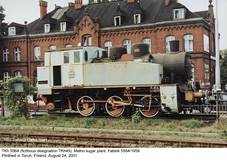
TKh-5564 (Fablok
5564/1959) plinthed at
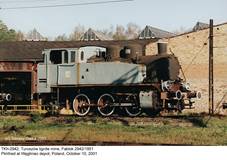
This machine (TKh-2942, Fablok 2942/1951),
now plinthed at Węgliniec loco depot, was used at Turoszów
lignite mine until 1990; photo taken on
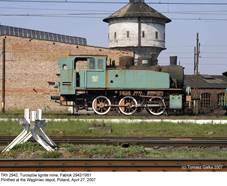
Another picture of TKh-2942, taken on April 27,
2007.
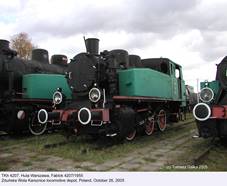
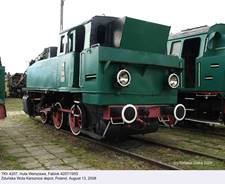
TKh-4207 (Fablok 4207/1955) at Zduńska Wola Karsznice loco
depot; photo taken on October 26, 2005.
Another picture of this engine, taken on August 13,
2008; note makeshift coal-box extension.
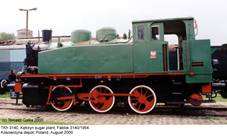
TKh-3140 (Fablok 3140/
1954) from the Kętrzyn sugar
plant at the Kościerzyna loco depot,
August 2000…
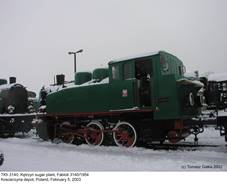
… and the same machine, snow-covered,
photographed on February 5, 2003.
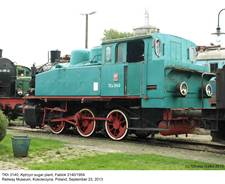
Another picture of this engine, taken on
September 23, 2013.
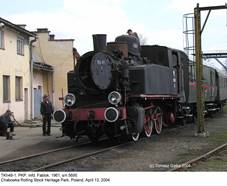
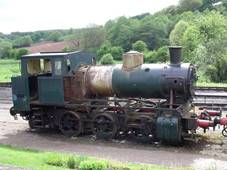
This beautiful TKh49-1 (Fablok
5695/1961), photographed at Chabówka heritage park on April 13, 2004, is the
only one owned (and operated – more photos here and here and also here) by PKP…
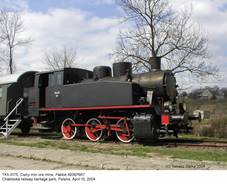
…while this one, photographed on the same occasion,
was displayed as TKh100- 191, while in fact this is the TKh-0175 (Fablok
4938/1957).
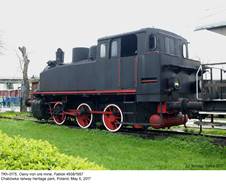
Another picture of the TKh-0175, with fictitious
designation removed; May 6, 2017.
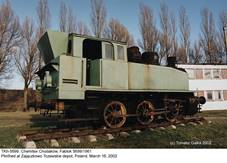
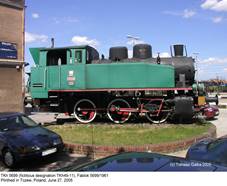
TKh-5699 (Fablok 5699/1961) is shown here plinthed at
Zajączkowo Tczewskie loco depot (March 16, 2002); a few months later this
machine was transferred to Tczew...
… and given fictitious designation TKh49-11 (photo
taken on June 27, 2005). Again, note makeshift coal box extension.
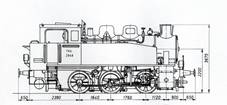
Side drawing, domestic variant (from PNP)…
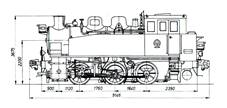
… and export version for China (drawing by
Edward Pokropiński from PPE).
This TKh-5376 (Fablok 5376/1956), once
operated by Chemitex-Anilana chemical
works, was photographed at Łódź Widzew station on June 7, 2000. Photo by Adam
Krzemiński – thanks for permission!
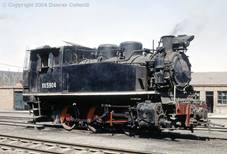
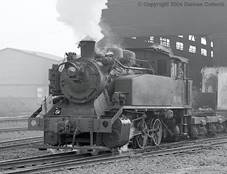
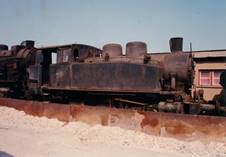
Two interesting photos of Chinese XK13s from
Duncan Cotterills' website (thanks for permission!): XK13 5904 at Baotou Steelworks, April 1988…
… and XK13 114 at Capital Iron & Steel Works, Beijing, January 1990 (note
footplates, modified cab and coal box).
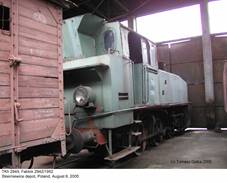
This TKh 2949 (Fablok 2949/1952) is owned by PSMK
and was photographed at the Skierniewice depot on August 6, 2005.
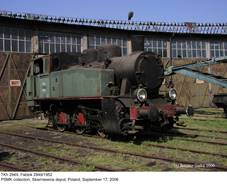
The same engine, photographed by the
Skierniewice shed on September 17, 2006.
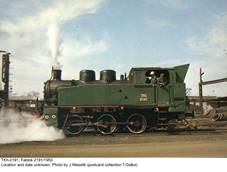
TKh 2191 (Fablok 2191/1950), location
and date unknown; photo by J.Weselik (postcard from my collection). This
engine was initially plinthed at the Railway Stock Repair Works in
Łapy…
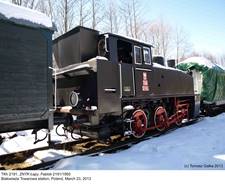
…which
went bankrupt in July 2009. Fortunately the engine was taken over by a
private owner and currently can be seen at the former Białowieża Towarowa
station, which has been converted into a restaurant and small hotel. Photo
taken on March 23, 2013.
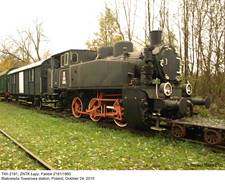
Another picture of this engine, taken on
October 24, 2015.
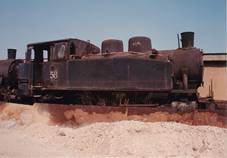
Three excellent pictures of Hungarian T3As
that had been purchased for Ózdi Kohászati Üzemek (Ózd Iron Works):
No. 58 (Fablok 5394/1959)…
…No. 59 (Fablok 5393/1959)…
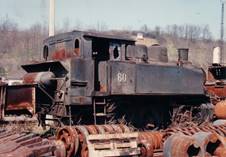
…and No. 60 (Fablok 5395/1959). All
pictures were taken in 1991 by Attila Kirchner – many thanks for the
permission!
TKh 2944 (Fablok 2944/1952), recently
purchased by a group of volunteers from the Churnet Valley Railway,
shortly after arriving in Cheddleton; June 1, 2013. Photo by Ian Calderwood (thanks
for permission!).
Another picture from Ian (thanks again!): TKh 2944 ‘Hotspur’ fully operational, photographed on
October 20, 2018.
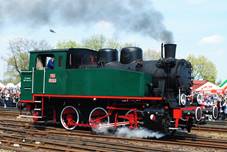
TKh 05353, owned by DB Schenker Rail Polska
and operated by KSK of Wrocław, photographed during the steam locomotives parade
at the Wolsztyn depot on April 30, 2016, by MacQtosh (source: www.commons.wikimedia.org).
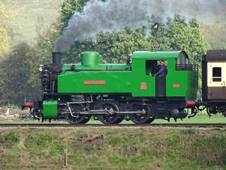
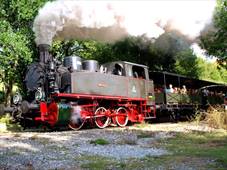
5703/1961 ‘Marine’, owned and operated by the Chemin de Fer Touristique du Haut-Quercy, location and date unknown (source: http://trainduhautquercy.info). |
Motive
power shortages after WWII called for rapid production of virtually all kinds
of locomotives, from heavy freighters to small switchers. The latter were
necessary primarily for major industrial establishments; factories which had
their own sidings needed simple and reliable engines designed for hard
everyday service rather than for brilliant performance. Demand for heavier
switchers was fulfilled by German OS (‘Oberschlesien’), built by Fablok since
1950 as T2D and commonly known as ‘Śląsk’ (Silesia). This 66-tonne
locomotive, with the tractive effort of 12.7 tonnes and axle load of 16.5
tonnes, was too heavy and powerful for many operators, so lighter switcher
was also needed. In
fact design of such machine was at hand. Between 1927 and 1929, Fablok built seven light tank locomotives with
factory designation T1A. These machines, which showed considerable influence
of Austrian designs, were later developed into T2A, known also as ‘Ferrum 29’ – after the name of steelworks that first
ordered this type. As technical documentation of the latter type fortunately
survived the war, it was quickly decided to build it afterwards, however with
certain changes. In particular, new machines ran on saturated steam, were
slightly lower, lighter by 1200 kg and their power was lower; diameter of
drivers was also slightly reduced. But their tractive effort was enough to
haul heavy drafts (even 1500 tonnes and more), they
were simple, undemanding and reliable, and axle load was only 14.8 tonnes. Combined
output of T1A and T2A had been small, less than twenty examples (data from
various sources differ considerably). New engine, with factory designation
T3A (commonly known as ‘Ferrum 47’), went into
series production in 1947 and, until 1961, 477 examples were built by Fablok. There are, in fact, some
discrepancies between various sources as far as the total output is
concerned; numbers from 437 to 480 are given. This total includes also later
variant, known as ‘Ferrum 724’, developed in order to fulfill foreign orders.
As early as in 1953, three machines were sold to Romania. In 1959 three (some
sources incorrectly give four) went to Hungary, purchased for the Ózdi
Kohászati Üzemek (Ózd Iron Works); one was withdrawn in 1987 and
the remaining two followed in 1991. Hungarian engines were unofficially
nicknamed ‘Gomulka’, after the first secretary of the Polish communist party
then in office. China bought probably 82 examples between 1958 and 1960; they
were designated class XK13 and some were fitted with makeshift tenders.
Chinese machines had air brakes, Janney couplers and electric lightning. It
should be noted that first machines for domestic use were fitted with steam
brakes and kerosene lights, in order to facilitate rapid deliveries. In fact,
differences between two basic variants were limited to details and all later
examples, not only export ones, were also built as ‘Ferrum 724’ type.
According to Duncan Cotterill’s very interesting and competent website on
Chinese steam power (www.railography.co.uk/tractive-efforts),
last XK13s were reported in service in 1993 and probably three examples have
been preserved at various locations. Given the fact that reliable sources
give 378 examples built for domestic operators, this leaves two examples;
possibly they went to Northern Korea (either directly or via China), as one
source reports export also to this country, but confirmation is lacking. The
lower you fly, the less you suffer when you’ve fallen down. This proverb (by
the way, Chinese) can easily be applied to this class. Despite obsolescence
of the basic design, they remained in service for quite a long time, just
like many other steam locomotives used by industrial establishments. At least
three were still used by a foundry in Ozimek in mid-1990s; it was intended to
keep them in operation until boiler certificate has expired – for one of them
it meant 2000, but further information is lacking. Common designation of
these engines was TKh (after wheel arrangement), followed by serial number –
a typical practice with industrial operators. This was, however, a practice
rather than a rule and there were some exceptions. As
many as seventeen examples have been preserved in Poland, although one of
them (TKh 2873, Fablok
2873/1951, in Pyskowice) is in poor condition and
dismantled. Currently (mid-2016) one engine of this type is in working order:
TKh 05353 (Fablok
3121/1953), originally built for the Lenin foundry, was transferred to PTK
Holding. At present it is formally owned by DB Schenker
Rail Polska and operated by Wrocław-based
KSK railway fans society. Its overhaul was completed in July 2008. Fablok 5695/1961 was transferred to the Chabówka railway stock heritage park in April 1997 and
restored in service. It was fitted with air brakes and electric lighting and
formally entered in the PKP rosters as TKh49-1. Previously it was used by the
Florian foundry in Świętochłowice as TKh 5695/9 and was one of the last steam locomotives
withdrawn from service in Poland. TKh49-1 saw much service with special
trains. At present it is awaiting overhaul, with boiler ticket expired. TKh 643 (Fablok 2181/1949),
originally built for a cement plant, was sold to France in 1992; however, it
remained in Poland, as its new owner intended to perform an overhaul at the Interlok company of Piła. This
was never completed and in April 2019 dismantled locomotive was transferred
to the Industry and Railway Museum of Jaworzyna Śląska. Further thirteen examples are on static display
or have been plinthed at various locations. For
reasons unknown to me, TKh-0145 (Fablok 4938/1957),
displayed in Chabówka, has purely fictitious
designation TKh100-191. TKh-5564, plinthed in Toruń, is designated TKh49, although this engine never
served with PKP; similarly, TKh-5699 plinthed in Tczew in 2002 (after spending a few years at the loco
depot in Zajączkowo Tczewskie),
is designated TKh49-11, although it has never had anything to do with PKP.
Very comprehensive list is available at www.polskieparowozy.pl. Withdrawal
of T3As from active service was comparatively late and coincided with rapidly
growing nostalgia for steam all over Europe. It is thus perhaps not
surprising that as many as nine machines were sold abroad. These are (status
as for early 2020): -
2871/1951 (sold in 1997 to Spa Valley Railway, UK, cannibalized, remains sold later to Churnet Valley Railway); -
2944/1952 (sold in 1997 to Spa Valley Railway, UK,
named ‘Hotspur’, withdrawn after boiler ticket expiry and sold to a group of
volunteers from the Churnet Valley Railway at Cheddleton, Staffordshire, restored in service in May
2014 – many thanks to Ian Calderwood for information); -
3135/1954 (sold in 1997 to Spa Valley Railway, UK,
named ‘Spartan’, in December 2014 sold to Swindon
& Cricklade Railway, a fundraising campaign
being raised in September 2015 to keep it operational); -
3138/1954 (sold in 1992 to Appleby Frodingham Railway Preservation Society, Scunthorpe, UK, withdrawn in 2009); -
3153/1954 (sold to Sweden in 1994 and initially plinthed in Sollentuna, in 2000
moved to the Harley-Davidson Sweden premises in Täby
Kyrkby, in 2018 transferred to Tallin,
Estonia); -
4015/1954 (sold in 1993 to UK, operated by Cholsey & Wallingford Railway, Pontypool & Blaenavon Railway, North Norfolk Railway and finally Avon Valley Railway, named ‘Karel’,
reported operational in late 2010, now under repair); -
5374/1959 (sold in 1992 to Northampton & Lamport Railway, UK,
named ‘Vanguard’, recently listed as a private property and offered for sale
in late 2016, non-operational); -
5387/1959 (sold in
1992 to Northampton & Lamport Railway, UK, named ‘Northamptonshire’,
sold to Stoomcentrum Maldege,
Belgium, in 2006 and restored in service in 2011); -
5703/1961 (sold in 2000 to Chemin de Fer Touristique
du Haut-Quercy, Martel, France, restored in
service in 2001 and named ‘Marine’, operational). Preserved Locomotives of
British Railways by Peter Fox and Peter Hall
(Platform 5, 2002) give slightly different details: according to this source,
as many as nine T3As were sold to British heritage railways; ‘Northamptonshire’s serial number is given as 3112/1952
and 2871/1951 is listed as belonging to Bridgend Valleys Railway. Two
more are listed, 5380/1960 and 5697/1959; both are actually kept in Pyskowice on static display. Main technical data
1)
In later examples (from mid-1950s). 2)
Some sources give 480. References and
acknowledgments -
PNP and PPE; -
Heritage Railway, various
issues; -
Tomisław Czarnecki (private communication – many
thanks for spotting an error concerning the engine from Kościerzyna in the
earlier issue of this entry!); also his website www.polskieparowozy.pl; -
Attila Kirchner (private communication – many thanks
for the photos and factory list!); -
Ian Calderwood (private communication – many thanks
for the photo!); -
http://trainduhautquercy.info
(website of the Chemin
de Fer Touristique du
Haut-Quercy). |
||||||||||||||||||||||||||||||||||||||||||||||||||||||||||||||||||||||||||||||||||||||||||||||||||||||||||||||||||||||||||||