TKr55
|
|||||||||||||||||||||||||||||||||||||||||||||||||||||||||||||||||||||||||||||||||||||||||||||||||||||||||||||||||||||||||||||
|
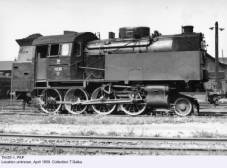
The sole TKr55-1, photographed at an unknown location in April 1959.
Photo from my collection.
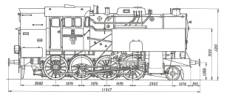
TKr55
side drawing from PPN.
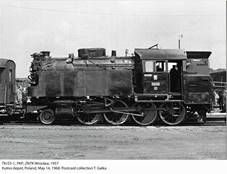
Another
picture of the TKr55-1: Kutno depot, May 14, 1968.
Postcard from my collection. |
After
WWII Polish state railways PKP obtained 575 American freight engines
of the S-160 Consolidation type, classed Tr201 (supplied by UNRRA
– 75 examples) and Tr203 (purchased from USATC stocks – 500 examples).
They were among the most important PKP locomotives during the first
post-war years and often ran with passenger trains. Their running qualities,
however, left something to be desired; they also had several minor
shortcomings, resulting mainly from simplified design. In early 1950s these
locomotives were shifted to switching or withdrawn and kept in reserve. Due
to modern boiler design and comparatively high efficiency, in 1952 it was
decided to marry their boilers with the undercarriages taken from Ok22
passenger engines. This hybrid was classed Ok203 (later Ok55) and two
examples were converted between 1952 and 1953. As results were considered
satisfactory, plans were eventually drawn to utilize all available Tr201s and
Tr203s in such manner. As a ‘by-product’, it was decided to use the S-160
frame and wheelsets to build a tank engine, fitted with a new boiler. Such
locomotive would be suitable for local traffic, both freight and passenger,
as well as capable to supplant a motley collection of obsolete and
inefficient switchers then in use with PKP and industrial operators. Detailed
design was completed in 1955. The prototype was built by ZNTK (Railway
Stock Repair Works) of Wrocław in 1957 and designated TKr55-1. Original
frame, wheelsets and steam engine were almost unchanged, apart from local
frame strengthening; rear coupled axle was given side-play of ±20 mm, in
order to allow negotiating curves 120 m in radius. New boiler, of welded
construction, was based on that of the TKt48 tank locomotive then in
production, but shortened by almost 900 mm, married with the Tr203
superheater and fitted with the rocking grate. Water and coal boxes, as well
as the driver’s cab, were also patterned on that of the TKt48. TKr55 turned
out as a successful engine, with low fuel consumption and ability to burn
low-grade coals. It, however, appeared too late. In 1957 it was decided to
terminate the development of steam locomotives in Poland and concentrate on
rapid electrification and diesel power. No more TKr55s were thus built. The
prototype was used for switching in Kutno until 1972; unfortunately, it has
not been preserved. It
may be argued that termination of steam traction development in Poland was
premature. Forecasts of electrification progress proved over-optimistic and
introduction of diesel power progressed nothing but smoothly. In effects,
obsolete and uneconomical steam switchers remained in use well into the
1980s. Main technical data
1)
Reconstruction.
References and
acknowledgments -
PNPP, PPN. |
||||||||||||||||||||||||||||||||||||||||||||||||||||||||||||||||||||||||||||||||||||||||||||||||||||||||||||||||||||||||||||