TKt48
|
|||||||||||||||||||||||||||||||||||||||||||||||||||||||||||||||||||||||||||||||||||||||||||||||||||||||||||||||||||||||||||||
|
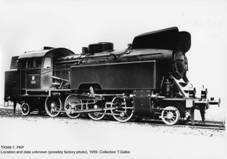
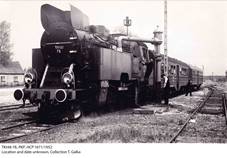
TKt48-?, location and date unknown; most probably this is a factory
photo. Photo from my collection.
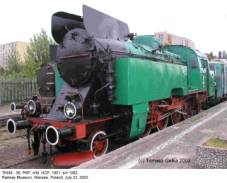
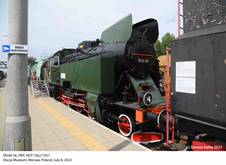
TKt48-36 (HCP
1562/1951) at the
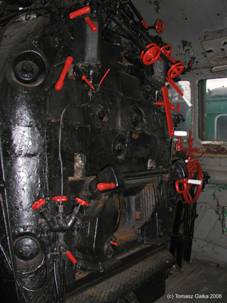
Cab interior of TKt48-36; photo taken on
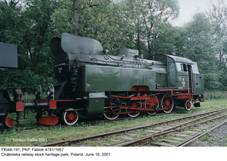
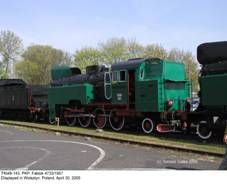
TKt48-191 (Fablok
4781/1957, last example built), Chabówka locomotive heritage park,
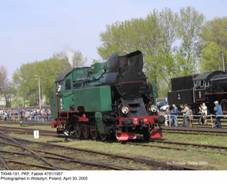
… and the same engine during the ‘Steam Locomotive
Parade’ at Wolsztyn depot,
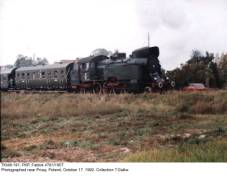
TKt48-191 with a special train near Prusy on
October 17, 1992. Photo by Wojciech Szpigiel (from my collection).
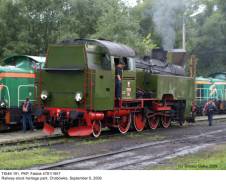
TKt48-191 once again in action: Chabówka, September
6, 2009.
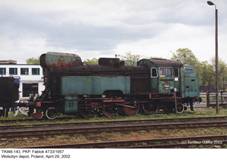
TKt48-143 (Fablok
4733/1957), photographed at Wolsztyn locomotive depot,
… and the same engine in much better condition,
almost exactly three years later (
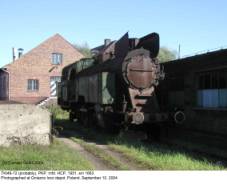
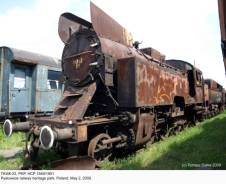
This derelict machine is most probably TKt48-72
(HCP 1663/1951); photo taken at
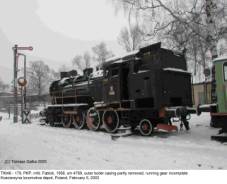
TKt48-179 (Fablok
4769/1956), Kościerzyna locomotive heritage park, February 5, 2003 (note
incomplete running gear and removed outer boiler casing).
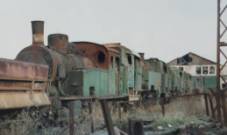
This interesting photograph by Geoff Sarbutt
(thanks for permission) shows in the background four derelict Albanian 01s;
Shkozet, March 1992…
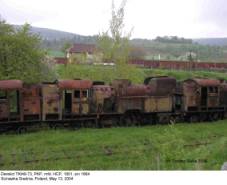
…and just for comparison: a lineup of derelict
TKt48s (TKt48-73, HCP 1664/ 1951 in the middle), photographed at Ścinawka
Średnia on May 13, 2004. All these engines were scrapped a few months later.
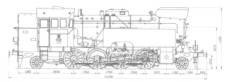
TKt48 drawing by Wojtek Lis from www.parowozy.com.pl
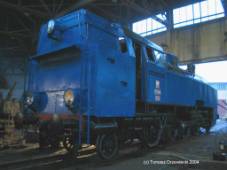
TKt48-188 at InterLok
premises in Piła shortly before test rides, August 14, 2004…
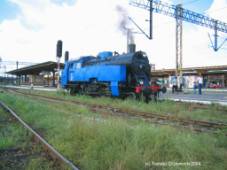
… and later that day at the Piła station. Both
photographs by Tomek Drzewiecki. TKt48s were popular machines and many are plinthed
at various railway premises. You can see some here.
Several TKt48s can be seen at the Industry and Railway Museum in Jaworzyna Śląska; you
can see some of them here.
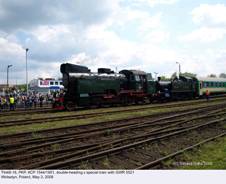
On April 28, 2007, TKt48-18 participated in
the Steam Locomotive Parade at the Wolsztyn depot; some pictures can be found
here. The above picture shows this engine
double-heading a special train with GWR 5521 at the 2008 Show; photo taken on
May 3.
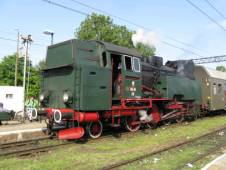
Two more pictures of the TKt48-18 in
regular service near Wrocław…
…both taken by John Bryant on May 27, 2008
(thanks for permission!).
TKt48-23 (HCP 1549/1951) is a part of
the TOZKiOS collection at the Pyskowice depot; photo taken on May 2, 2009.
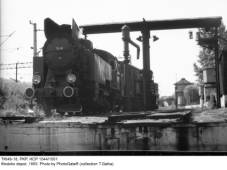
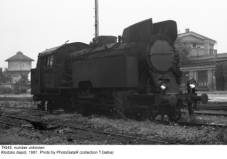
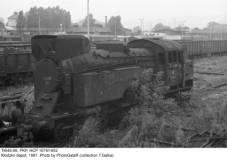
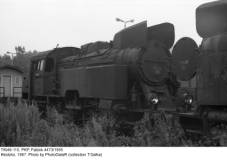
Four older pictures of TKt48s: TKt48-18,
still operational (see above), photographed at the Kłodzko depot in 1993…
…an unknown – possibly withdrawn … TKt48,
photographed at the same location in 1987…
…another picture taken at this location in
1987: TKt48-86 (HCP 1679/1952)…
…and one more: TKt48-110 (Fablok
4473/1955). All photos by PhotoGataR (from my collection). Feel free to visit
http://photogatar.com to see a gallery
of (not only) railway-related pictures.
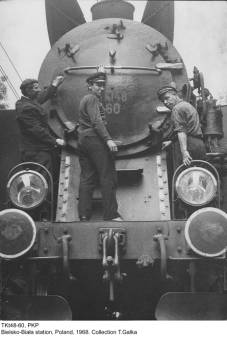
Another picture from my collection:
railwaymen posing on the TKt48-60 at the Bielsko-Biała station, 1968.
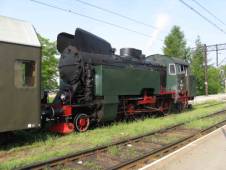
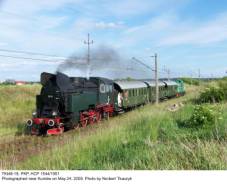
TKt48-18 again, this time with a special train
near Kuniów on May 24, 2009. Photo by Norbert Tkaczyk (used by permission).
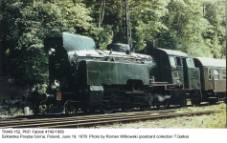
TKt48-152 (Fablok 4742/1956),
photographed in Szklarska Poręba on June 19, 1978. Photo by Roman Witkowski
(postcard from my collection).
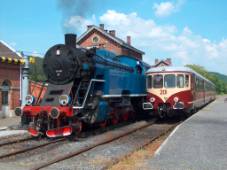
Four photos by Yves Godrie (many thanks!):
TKt48-87 with the 201-211 DMU, Treignes, Belgium, June 1, 2009…
…the same engine, this time with the BB
63149, Treignes, December 18, 2009…
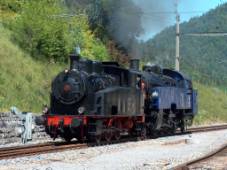
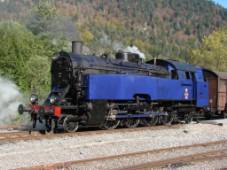
…TKt48-188, posing with the E 3-3 16388,
Travers, Switzerland, June 11, 2006…
…and the same engine, photographed in
Saint-Sulpice, Switzerland, on October 13, 2007.
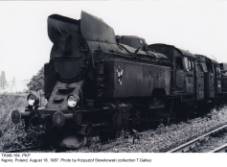
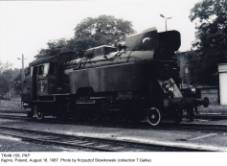
Four older pictures from my collection. Derelict TKt48-164, Kępno,
August 18, 1987 (photo by Krzysztof Słowikowski)…
…TKt48-158, the same location, date and
author…
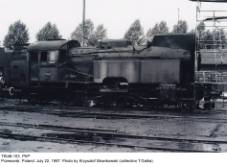
…TKt48-103, Przeworsk, July 22, 1987 (the
same author)…
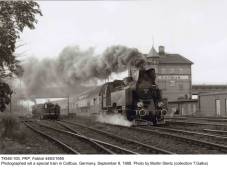
…and TKt48-100, photographed with a special
train in Cottbus, Germany, on September 8, 1988 (photo by Martin Stertz). The
engine in the background is DR 44 2225-9.
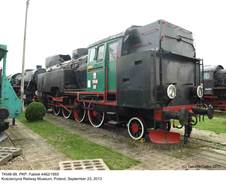
TKt48-99 (Fablok 4462/1955) on display at
the Kościerzyna Railway Museum; September 23, 2013.
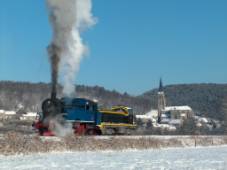
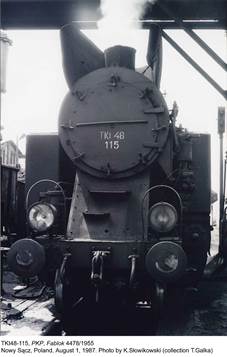
THt48-115 (Fablok 4478/1955), photographed
in Nowy Sącz on August 1,
1987. Photo by K.Słowikowski (from my collection).
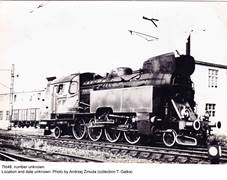
TKt48, number, location and date unknown.
Photo by Andrzej Żmuda (from my collection).
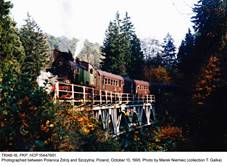
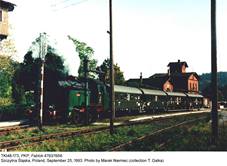
Three more pictures from my collection
(photos by Marek Niemiec): TKt48-18 (HCP 1544/1951), photographed between Polanica Zdrój and Szczytna on October 13, 1995…
… TKt48-173 (Fablok 4763/1956) in Szczytna, November 25, 1993…
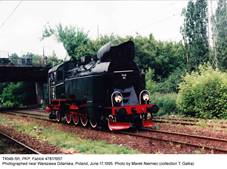
… and TKt48-191 (Fablok 4781/1957), photographed
during its visit to Warsaw on June 17, 1995.
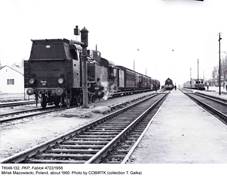
TKt48-132 (Fablok 4722/1956), photographed
in Mińsk Mazowiecki around 1960. Photo by COBiRTK (from
my collection).
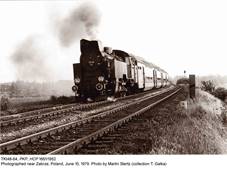
TKt48-64 (HCP
1661/1952) with a local train, photographed near Zabrze on June 10, 1979.
Photo by Martin Stertz (from my collection).
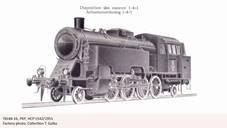
Factory photo of the TKt48-16 (from my
collection).
Another picture from my collection: TKt48-78
(HCP 1671/1952), location and date
unknown. This locomotive was written off in 1990.
Back to Warsaw: TKt48-36 again, Stacja Muzeum
(formerly Railway Museum), July 6, 2023. |
TKt48 was the first new locomotive of Polish design,
built for PKP after WWII; earlier
ones were either slightly modified pre-war indigenous designs (Ty45, Pt47) or
direct derivatives of machines built during the war under German supervision
for DRG (Ty42, Ty43). Despite its
designation, it was intended mainly for passenger trains. A need for such locomotive resulted mainly from
rapidly developing suburban traffic around largest cities (mainly Warsaw and
Upper-Silesian agglomeration). In fact, first European 1-4-1 tank engines
were designed for such service. Quite surprisingly, the palm goes to Russian
railways, but their class Д (D), later re-classed ЪH,
was not successful and all fourteen machines, built between 1910 and 1914,
were soon relegated to switching. Locomotive of such type was also needed on
mountain lines in southern Poland, where a mixture of old machines (classes
TKt1, TKt2, TKt3 and Tr6, supplemented by a handful of pre-war OKz32s) had
been operated for a long time. These lines were characterized by steep
gradients, tight curves and often no turntables at terminal stations. Both
these tasks demanded high tractive effort, rather than high speed, and good
running qualities in both directions. Due to these factors, diameter of
drivers was chosen at only 1450 mm, which qualified new locomotive as a
freight engine (although pre-war OKz32 had drivers of exactly the same
diameter!). In fact it was seldom used with freight trains, at least
initially. After initial problems with uneasy running
(eradicated by suspension modifications and improved Krauss-Helmholtz trucks)
and boiler draught, the machine was considered successful. It had first been
planned to supply first engines in the end of 1949, but eventually they were
delayed by almost one year. TKt48s were built between 1950 and 1957 by both HCP (Cegielski)
and Fablok. First 99 machines (all except
eight for PKP) were supplied
between 1950 and 1952 and then production was resumed again in 1955. Examples
built from 1955 onwards – by Fablok only,
starting from TKt48-92 – designated TKt48/2, had some modifications,
including wider introduction of welding instead of riveting in boiler design,
Trofimov piston valves, slightly enlarged water
boxes, modified boiler dome and fully enclosed cab. Earlier machines were
later brought to this standard during overhauls. Many sub-assemblies,
accessories and fittings were the same as in older classes, thus introducing
some standardization. On this account, some authors don’t regard this machine
as an original design, claiming that it was a compilation of various earlier
ones. This, however, is certainly an exaggeration. There are some discrepancies concerning the total
output from two above-mentioned factories. According to recent and reliable
sources (e.g. monograph by Ryszard Stankiewicz – see References), HCP built 88 machines, of which 78 went to PKP. Fablok
output amounted to 115 examples, all but two going to PKP. This gives a total of 203 TKt48s. Six HCP-built engines (1680/1952 through 1685/1952) and two Fablok-built
ones (2922/1951 and 2923/1951) were sold to Albania. The remaining four
machines from HCP (1686/1952,
1844/1952, 1845/1952 and 1846/1952) went directly to industrial operators and
never served with PKP. According to
some older references, several (nine?) examples were sold to Northern Korea,
but recent sources (e.g. comprehensive lists by Paweł
Mierosławski, published in KDD vol. 4/2005, or the above-mentioned monograph) don’t confirm
this. Similarly, export of six machines to the USSR (and hence the grand
total of 209 examples), mentioned in some sources, have not been confirmed.
Some older sources give the grand total of 199, including 102 built by Fablok and 97 by HCP. TKt48-191 was the last steam locomotive for PKP built
by Fablok. Eight Albanian locomotives operated by state
railways Hekurudha Shqiptare (HSH)
were designated Class 01 and given service numbers from 01 to 08; however,
they reportedly retained the ‘TKt48’ plates. Most probably they were first
new locomotives, acquired by HSH
after WW II and supplementing a motley collection of old, mostly ex-Italian
ones. Details of their service are few. 06 was reported in Durrës in 1986, in good condition. According www.angelfire.com/ak/hekurudha,
two examples – 04 and 05 – were used for switching at the Durrës
harbor and one was still there in 1987. The same source reports five machines
abandoned in Shkozet, where some of them remained
at least until March 2001; a photograph by Geoff Sarbutt,
taken in 1992, shows four of them (Geoff has given me the permission to show
his photo here – thanks a lot!). Later feedback (again from Geoff – June
2004) confirmed that they survived at least until early 2000s. Two examples
have reportedly been preserved. There are some rumors about plans concerning
tourist trains hauled by 01s, but no details are available; most probably
nothing in fact has been done about it. Most machines – 191 – were used by PKP. First batch went primarily to
suburban lines, while machines built from 1955 onwards were intended mainly
for local traffic in southern Poland, where they gave very good service.
Polish railways had considerable problems with acquiring a diesel locomotive
for local passenger traffic (SP42, developed from the SM42 switcher, was too
weak, while SP32, built in Romania, appeared only in mid-1980s, also lacked
power and was plagued with failures), so TKt48s remained in that service as
the last steam engines with scheduled trains in Poland. According to some
sources, last of them were withdrawn from line service in early 1992, but
some were reported operational in 1995. Of four ‘industrial’ TKt48s two
examples, converted for 1524 mm track and based in Elbląg,
were for some time used for switching freight and passenger cars built in
Poland for Soviet railways, operating on one of the few broad-gauge lines in
Poland, between Elbląg and Braniewo.
TKt48s were good steamers and reliable engines, characterized
by high tractive effort and fast startup. They were popular and very easy to
recognize, due to their characteristic silhouette with prominent smoke
lifters (these were, however, introduced during service and there are many
old photos of engines without them). Many machines have survived until today.
A list published in SK vol. 2/1999 gives as many as 45 surviving
examples in Poland, plus two abroad. Current lists (early 2020), available at
www.polskieparowozy.pl, give as
many as 34 examples that still can be seen at various locations in Poland;
in the meantime, one was sold and ten
scrapped. One engine of this type, namely TKt48-191 (Fablok 4481/1957), the last one
impressed into PKP service and the
last steam engine built for PKP by
this manufacturer, now in Chabówka Railway Stock
Heritage Park, is kept in working order and sometimes hauls special trains.
In April 2005 this machine participated in the traditional ‘Steam Locomotive
Parade’ at Wolsztyn depot. Second engine of this
class in working order is TKt48-18 (HCP
1544/1951), property of the Industry
and Railway Museum of Jaworzyna Śląska. Cleared for service after a major overhaul in
August 2006, it is based in Wrocław and sometimes
runs with scheduled trains. TKt48-179 (now in Kościerzyna
locomotive heritage park) has its boiler outer casing partly removed, to
serve as a sort of ‘educational exhibit’ showing boiler interior. As
mentioned above, three more heritage machines were sold abroad. TKt48-160 (Fablok
4750/1956), sold in 1992, was initially put on static display in Oebisfelde,
Germany; currently it is operated by Museumseisenbahn
Hanau. TKt48-87 (HCP 1848/1952)
was purchased by Le
Chemin de Fer á Vapeur des Trois Vallées, Treignes, Belgium; some
sources claim that the Belgian machine is in fact TKt48-67 (Fablok 2926/1951), which is not true.
TKt48-188 (Fablok 4778/1957, recently used
by the railway stock repair establishment in Łapy)
was purchased by Vapeur Val de Travers
of Switzerland and overhauled by InterLok
company in Piła. Rolled out in August 2004 with
slightly lower cab and removed smoke lifters (due to different vehicle
gauge), in new blue livery, it underwent tests in Poland before departure to
Switzerland. In the meantime, some railway fans were lucky enough to take
photos (one of them was Tomek Drzewiecki; you can
see two of his pictures here – thanks for permission! More can be found at www.parowozy.strefa.pl). Main technical data
-
Some sources give 14 200 mm -
Including four machines for industrial operators References and
acknowledgments - A
series of articles by Paweł Mierosławski and Krzysztof Wiśniewski (KDD
vol. 1 to 4); - TKt48 – lokomotywa towarowa do pociągów osobowych (TKt48 – Freight Locomotive for Passenger Trains) by Ryszard Stankiewicz (Eurosprinter,
2019); - AP,
PNP; - www.parowozy.best.net.pl (website
by Michał ‘Doctor’ Pawełczyk); -
www.polskieparowozy.pl (website
by Tomisław Czarnecki); - Tomasz
Drzewiecki and Yves Godrie
(private communication – thanks for the photos!). . |
||||||||||||||||||||||||||||||||||||||||||||||||||||||||||||||||||||||||||||||||||||||||||||||||||||||||||||||||||||||||||||