OKl11
|
|||||||||||||||||||||||||||||||||||||||||||||||||||||||||||||||||||||||||||||||||||||||||||||||||||||||||||||||||||||||||||||
|
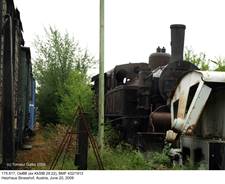
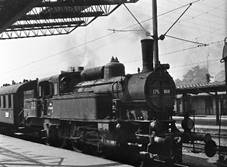
The sole surviving 175.817 (ex kkStB
29.22), BMMF 432/1912, photographed at the Heizhaus Strasshof on June 20, 2009. It’s not easy
to take a better photo…
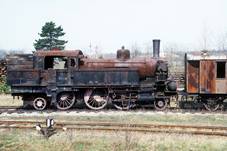
… but it used to be in
the past. Photo taken by Herbert Ortner on April 4,
1999 (source: www.commons.wikimedia.org).
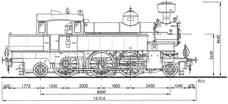
OKl11 side drawing by M. Ćwikła;
source: SK vol.3/2003.
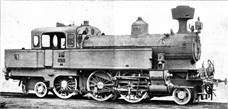
KkStB
29.01 (BMMF
411/1912), location and date unknown – probably a factory photo. After 1918
this locomotive became OKl11-1; captured by Germans and re-numbered
75 827, it was then taken over by ČSD
and withdrawn in 1950s. Source: Dle Lokomotive August
1913.
ÖBB 175.808
(ex kkStB
29.12, then DRG
75 808), BMMF
422/1912, photographed in Villach, Austria, in 1952. This engine was
withdrawn in June 1959. Source: www.commons.wikimedia.org.
|
Between
1904 and 1918 Austro-Hungarian state railways KkStB
(Kaiserlich-königliche österreichische
Staatsbahnen) received 239 very successful
class 229 tank locomotives for passenger and light express trains. They
featured 1-3-1 axle arrangement, were fitted with compound engines and ran on
saturated steam. Twenty-five very similar locomotives were built for other
railway managements; furthermore, seventeen earlier class 129 engines (1-3-0
axle arrangement) were later rebuilt to this standard. After WWII, class 229
served with PKP as OKl12 (described under a separate entry). Early
20th century saw the introduction of steam superheating, as a
means to improve engine efficiency and economy. A variant of class 229
running on superheated steam was thus designed and emerged in 1912 as class
29. This designation was used for the second time, after a batch of fifteen
engines built for Kronprinz Rudolfs-Bahn by Sigl
between 1868 and 1869 – surviving old engines were duly re-classed 929.
Boiler was fitted with eighteen smoke tubes, high-pressure cylinder was
increased in diameter from 420 to 450 mm and piston valves replaced slide
ones. In order to keep axle load below 14.5 tonnes,
water boxes had to be shortened and rear part of the frame was increased in
length by 250 mm. Class 29, however, was not as successful as its
predecessor. Coal and water consumption were lower indeed, but due to
evaporating surface reduced by almost nine percent boiler capacity was
sometimes insufficient. Tractive effort was marginally lower. A batch of 36
examples (three from WLF and 33 from BMMF) was delivered in
1912 and then production shifted back to well-proven 229. After WWI Austrian state railways BBÖ
were left with 26 examples of class 29. After Anschluss all were taken
over by DRG and re-numbered 75 801 through 826. Returned after the
war, they became ÖBB class 175; last survived in service until 1962.
29.18 went to JDŽ and was designated 116-017 (in 1941 it was captured
by Germans and became 75 836). The remaining nine 29s were taken over by PKP;
after 1925 they were classed OKl11. Initially assigned to the Kraków regional management, in mid-1930 all were
transferred to Katowice, to serve with local passenger trains. In 1939 all
OKl11s were captured by Germans and impressed into DRG service in
Austria as 75 827 through 835. Immediately after the war two were in Hungary
and one in the Soviet Union. In 1948 three returned from Austria; re-numbered
OKl11-1 through -3, they were impressed into PKP service, but one was
withdrawn in 1950 and the remaining two three years later. In 1953 two more
followed from Hungary (one from MÁV and one from GySEV),
but, despite being assigned PKP service numbers OKl11-4 and OKl11-5,
they went directly to industry (collieries). One of them remained in use
until 1961. Unfortunately, none has been preserved. Only
one locomotive of this type has survived until today. KkStB
29.22 (BMMF 432/1912), later DRG 75 817, then ÖBB
175.817, withdrawn from use in 1956, can be seen on static display in Austria
at the Heizhaus Strasshof. Main technical data
1) 1574 mm according to Austrian standards
(medium-degree flange wear). List of vehicles can be found here.
References
and acknowledgments
-
Monographic article by Paweł
Terczyński (SK vol. 3/2003); -
EZ, LP, EDÖ; -
www.pospichal.net/lokstatistik
(website by Josef Pospichal); -
http://republika.pl/derela
(website by Michał Derela
– information on armored locomotives). |
||||||||||||||||||||||||||||||||||||||||||||||||||||||||||||||||||||||||||||||||||||||||||||||||||||||||||||||||||||||||||||